Research / five connected programs

Quantum control as a tool for discovery

Our experiments span nuclei, atoms, ions, and molecules. Across those scales, the common aim is precise: understand quantum interactions deeply enough to use them for new measurements, new technologies, and new tests of nature.

01Quantum standards

Thorium-229 nuclear clock

The thorium-229 isomer is the lowest-energy known nuclear excited state and can be addressed with table-top laser technology. We investigate trapped-ion and solid-state architectures, the microscopic physics of clock host materials, and new spectroscopic techniques that turn this unusual nucleus into both a precision clock and a probe of its environment.

Selected Publications
  • Solid-state and trapped-ion clock architectures
  • Laser Mössbauer and conversion-electron spectroscopy
  • Host-material shifts, defects, and quenching channels

Materials for precision spectroscopyA crystal under illumination
An illuminated crystal glowing pink and blue in the laboratory
02Quantum information

Molecular quantum logic

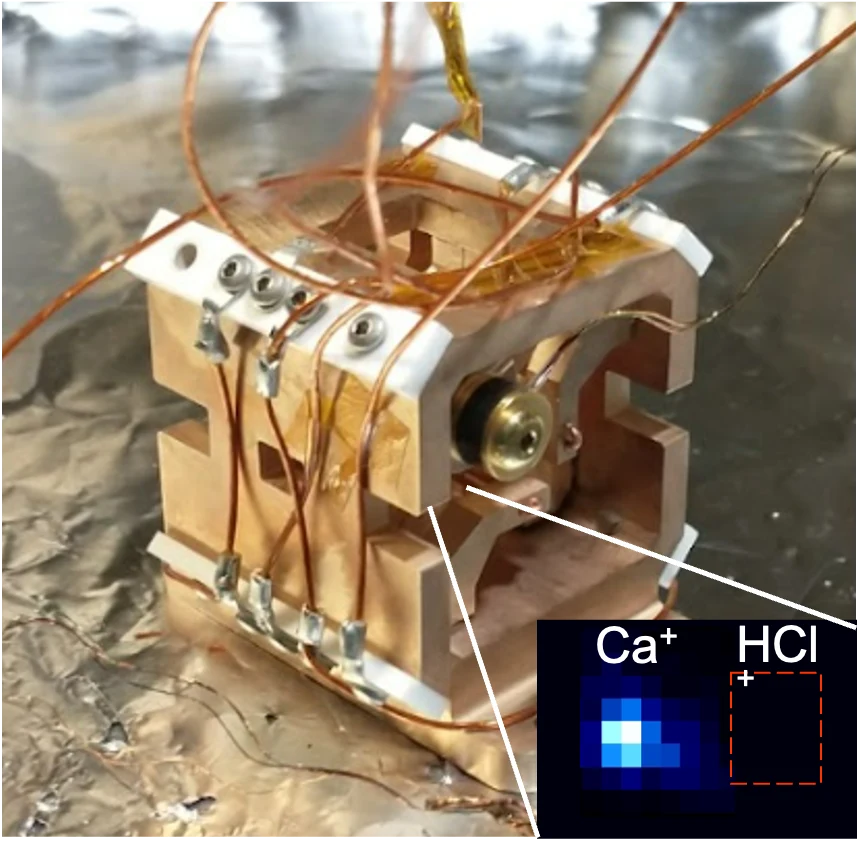
Molecules offer rich internal structure, but that same complexity makes conventional optical control difficult. Electric-field gradient gates address low-lying molecular transitions with radio-frequency and microwave fields, opening a path to quantum logic, state detection, and precision spectroscopy without the photon-scattering limits of laser-driven gates.

Selected Publications
  • Electric-field gradient gates (EGGs)
  • Cryogenic HCl⁺ / Ca⁺ quantum-logic platform
  • Quantum-enabled molecular mass spectrometry
A controlled environment for ions and moleculesInside the apparatus
The molecular quantum logic ion trap with an inset showing calcium and hydrogen chloride ions
03Precision measurement

Wideband quantum sensing

Motional Raman transitions down-convert an arbitrary-frequency electric field into a measurable displacement of a trapped ion. We use this interaction for complete waveform sensing, quantum amplification, super-resolution, and nonlinear protocols that improve precision beyond familiar linear limits.

Selected Publications
  • Quantum vector signal analysis
  • Nonlinearity-enhanced frequency sensing
  • Broadband super-resolution and quantum amplification
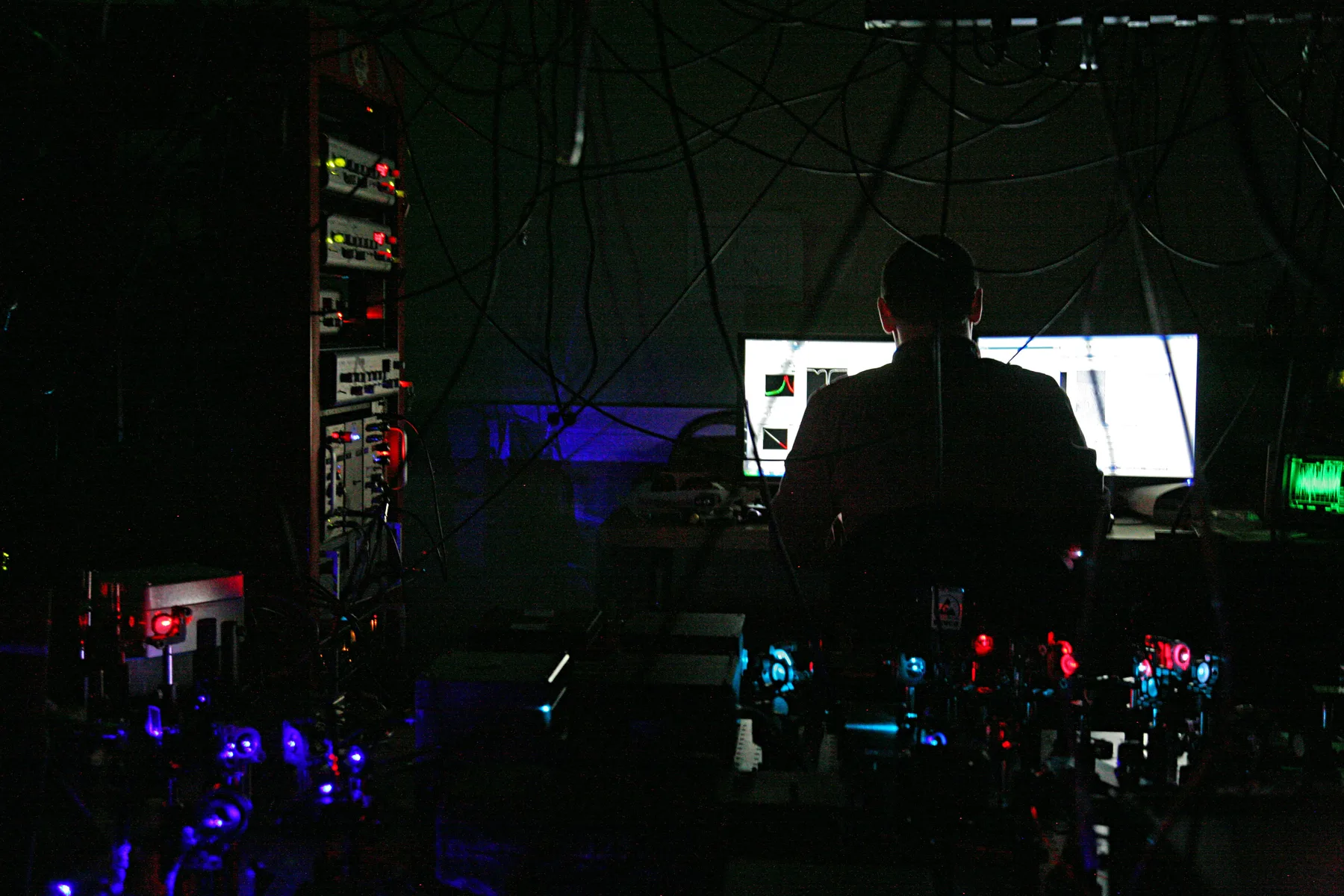
Optics, electronics, and quantum controlMeasurement in progress
A researcher surrounded by illuminated optics and laboratory instruments
04Controlled matter

Cold chemistry & complex molecules

Hybrid traps and cold molecular beams reveal chemical dynamics in a regime where individual quantum states matter. In parallel, we study how optical cycling survives as molecules grow larger—work that may bring direct laser cooling and high-fidelity state detection to a new class of molecular systems.

Selected Publications
  • Cold atom–ion and molecule–ion reactions
  • Optical cycling in functionalized arenes
  • Cold beams of polyatomic molecules
05Trapped-ion systems

Barium-133 qubits

Barium-133 combines a clock-state qubit with visible-wavelength transitions for initialization and detection. Together with collaborators, we develop the isotope’s control toolbox, scalable optical delivery, and methods that protect coherence while simplifying the hardware required for trapped-ion quantum processing.

Selected Publications
  • Clock-state quantum control
  • Broadband integrated photonics
  • High-fidelity initialization and readout
06Collaborative search

HUNTER sterile-neutrino search

HUNTER brings atomic, nuclear, and particle physicists together to search for keV-scale sterile neutrinos through energy–momentum reconstruction of electron-capture decays in a laser-cooled radioactive source.

Selected Publications
  • Laser-cooled radioactive atoms
  • Precision decay reconstruction
  • Searches for dark-matter candidates

Community / UCLA

Quantum matter in Los Angeles

The group is part of a broad UCLA community working across atomic, molecular, optical, condensed-matter, chemical, and quantum-information science.

Center for Quantum Science & Engineering