Atomic, Molecular, and Optical Physics
Our research focuses on the study of quantum interactions, information, and metrology, as well as tests of the foundations of fundamental physics. Towards these goals, we are developing and implementing methods for trapping ultra-cold polar molecular ions and constructing a solid-state optical frequency standard, based on a low-lying transition in the 229Th nucleus. For more information please click on the links to the left.
Featured Research
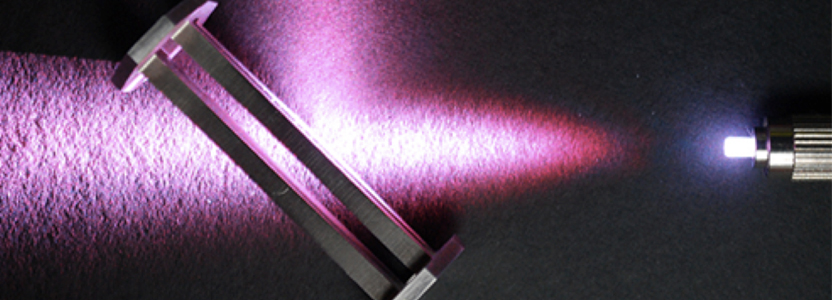
Creating a Nuclear Clock
Our laboratory is developing a new type of clock based on a nuclear transition inside the A = 229 isotope of thorium. A nuclear clock has several advantages over traditional atomic clocks. First, because atomic electrons screen the nuclear oscillator, detrimental environmental effects that limit atomic clock performance are removed. And second, because of the large interaction energies associated with the strong nuclear force, the clock frequency is roughly one million times more sensitive to any variation in the fundamental constants of nature. These traits combine to suggest it may be possible to measure e.g. any variation of the finestructure constant α to better than 1 part in 1020!
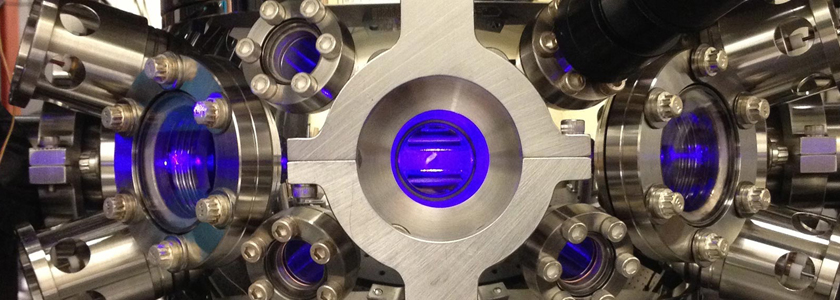
Studying Ultracold Molecular Ions
Because molecular ions are easily trapped for many minutes (due to their excess charge), there are possibilities for cooling and interrogation that are not applicable to neutral molecules. Utilizing this feature, our lab has recently proposed a new method to produce ultracold molecular ions via sympathetically cooling collisions with ultracold atoms. Similar to an ice cube cooling a drink, overlapping a cloud of ultracold calcium atoms with a cloud of trapped molecular ions can quickly cool the molecular ions to ∼1 mK.
Hudson AMO Physics research funded by: